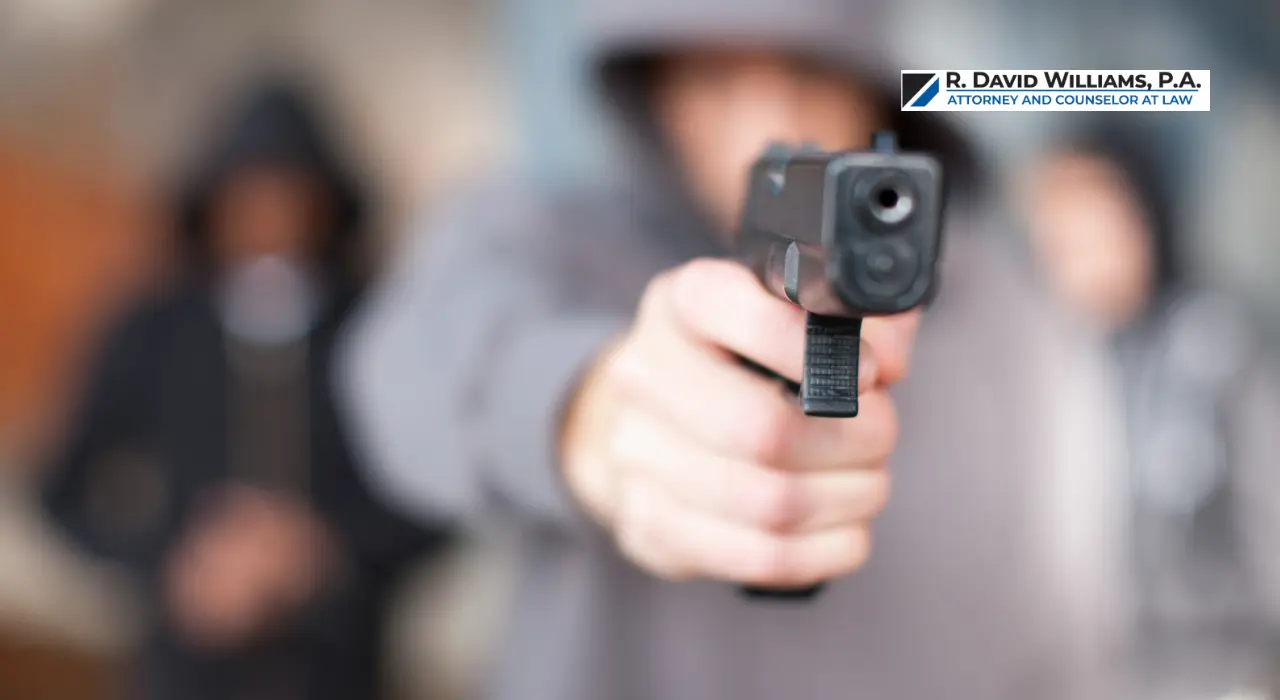
In the vibrant community of Fort Lauderdale, owning a firearm is a right many cherish. However, that right comes with significant legal responsibilities. One of the most serious errors a gun owner can make is discharging a firearm within city limits or in populated areas.
Under current legislation, discharging a firearm in public in Florida is not viewed as a minor lapse in judgment; it is a criminal offense that the Broward State Attorney’s Office pursues with vigor. Whether an incident involves a "celebratory" shot or a moment of reckless behavior, the consequences within the 17th Judicial Circuit Court can be life-altering. This guide provides an essential look at the statutes, the tiered penalty system, and the legal hurdles you may face. Contact the Law Offices of R. David Williams, P.A. to discuss your case.
Understanding the legal thresholds for firearm use in Fort Lauderdale is essential to avoiding severe felony penalties. Here are the critical takeaways regarding discharging a firearm in public in Florida:
The primary law governing this offense is Florida Statute § 790.15. This statute makes it illegal to knowingly discharge a firearm in any public place, on the right-of-way of any paved public road, or over occupied premises.
In Broward County, the definition of a public place is broad. It includes:
Florida law applies a tiered approach to sentencing based on the location of the discharge and whether a vehicle was involved. In Fort Lauderdale, these cases are processed through the Broward County Main Judicial Center, where the charge's degree determines the potential sentence's severity.
Most instances of discharging a firearm in public in Florida are classified as first-degree misdemeanors. This applies when someone "knowingly" fires a gun in a public place or over occupied premises.
The law escalates significantly if the discharge occurs from within a vehicle. Under Statute § 790.15(3), a driver or owner who directs another to discharge a firearm from their vehicle faces a third-degree felony charge.
An occupant of a vehicle who knowingly and willfully discharges a firearm from the vehicle within 1,000 feet of another person commits a second-degree felony. The state views this as a direct threat to public safety, warranting much harsher retribution.
A related but far more severe charge is "Shooting into an Occupied Building or Vehicle" under Florida Statute § 790.19. If a projectile enters a public or private building, occupied or not, or an occupied vehicle, it is classified as a second-degree felony.
In Fort Lauderdale, prosecutors often use this statute when a bullet accidentally enters a neighbor's home. Even if there was no intent to harm anyone, the "malicious or wanton" nature of the act is enough for a conviction, which carries a maximum of 15 years in prison.
While the 10-20-Life law (Statute § 775.087) was amended to provide more judicial flexibility, it remains a factor in cases where discharging a firearm is linked to a "forcible felony" (such as aggravated assault or robbery). If a firearm is discharged during the commission of a listed felony, the court may be required to impose a 20-year mandatory minimum prison sentence.
Even without a forcible felony, the 17th Judicial Circuit judges often view firearm discharge as a high-risk behavior, making "adjudication withheld" outcomes, which can prevent a permanent criminal record, more difficult to secure without a skilled legal defense.
Facing a firearm charge is daunting, but an arrest is not a conviction. A seasoned legal advocate will investigate several avenues of defense to protect your rights:
In most cases, yes. Under Florida Statute § 790.15, it is a first-degree misdemeanor to recklessly or negligently discharge a firearm on property used primarily as a dwelling or zoned exclusively for residential use. While rural landowners in some parts of Florida may have more leeway, the high density of Broward County means that firing outdoors in a typical neighborhood is a criminal offense.
A "knowing" discharge occurs when you intentionally pull the trigger in a public place. "Reckless" discharge implies a gross deviation from the standard of care a reasonable person would exercise, such as target practicing in a backyard near other homes. Both can lead to significant jail time in the 17th Judicial Circuit, though "reckless" behavior in residential areas is a specific focus of local law enforcement.
Under the 10-20-Life law (Statute § 775.087), if a firearm is discharged during the commission of certain felonies, a 20-year mandatory minimum applies. While the law was amended to allow judges more discretion in specific self-defense scenarios, a "warning shot" can still be charged as aggravated assault with a firearm. A skilled attorney is needed to argue for self-defense and seek to avoid these harsh mandatory minimums.
If the discharge was truly accidental, for instance, a mechanical failure or a stumble, you may lack the "willful" or "negligent" intent required for a conviction. However, the state often treats any discharge in a public area as negligent. A seasoned legal team would work to gather forensic evidence or solid testimony to show that the event was an accident rather than a criminal act.
A felony conviction in Florida leads to the loss of your civil rights, including the right to possess a firearm. While a misdemeanor discharge charge may not automatically revoke your rights under federal law, it can influence your ability to maintain a Concealed Weapon or Firearm License (CWFL). Protecting your rights under the law early in your case is the right way to prevent the permanent loss of your Second Amendment privileges.
A conviction for discharging a firearm in public in Florida does more than just threaten your freedom; it jeopardizes your right to own firearms in the future and leaves a permanent mark on your background check. For professionals, it can lead to the loss of licensing or employment.
Having a respected advocate who focuses on firearm defense is essential. A knowledgeable legal team works on your behalf to scrutinize the evidence, challenge the prosecution’s narrative, and pursue a resolution that seeks to minimize the impact on your life.
If you are involved in a firearm-related investigation in Broward County, taking immediate action is the most effective way to protect your rights under the law.
I’m Fort Lauderdale criminal defense attorney R. David Williams. When you call the Law Offices of R. David Williams, P.A., you speak directly with me. I take the time to review the facts of your case, assess the theft charge and any prior record, explain how a conviction could affect your employment and future in Florida, and discuss the defense options available to you.
Call (954) 522-9997 to schedule your free consultation, or use the confidential online form to contact me directly. Same-day responses are common, and after-hours support is available.
Knowledge | Experience | Integrity – R. David Williams
Copyright © 2026. Law Offices of R. David Williams, P.A. All rights reserved.
The information in this blog post (post) is provided for general informational purposes only and may not reflect the current law in your jurisdiction. No information in this post should be construed as legal advice from the individual author or the law firm, nor is it intended to be a substitute for legal counsel on any subject matter. No reader of this post should act or refrain from acting based on any information included in or accessible through this post without seeking the appropriate legal or other professional advice on the particular facts and circumstances at issue from a lawyer licensed in the recipient’s state, country, or other appropriate licensing jurisdiction.
Law Offices of R. David Williams, P.A.
15 Southwest 10th Street
Fort Lauderdale, FL 33315
(954) 522-9997
https://dwilliamslaw.com/
Call (954) 522-9997 or fill out the short form below. We will usually respond within 1 business day but often do so the same day. Don’t hesitate, your questions are welcome.
* Required Fields
After-hours support is Now Available!
We are thrilled to introduce our after-hours answering service, which ensures prompt response to all of your queries regardless of the time. Our dedication to your satisfaction extends beyond regular business hours. Please feel free to contact us anytime; we will be more than happy to assist you.


The information you obtain at this site is not, nor is it intended to be, legal advice. You should consult an attorney for advice regarding your individual situation. Contacting us does not create an attorney-client relationship.


