
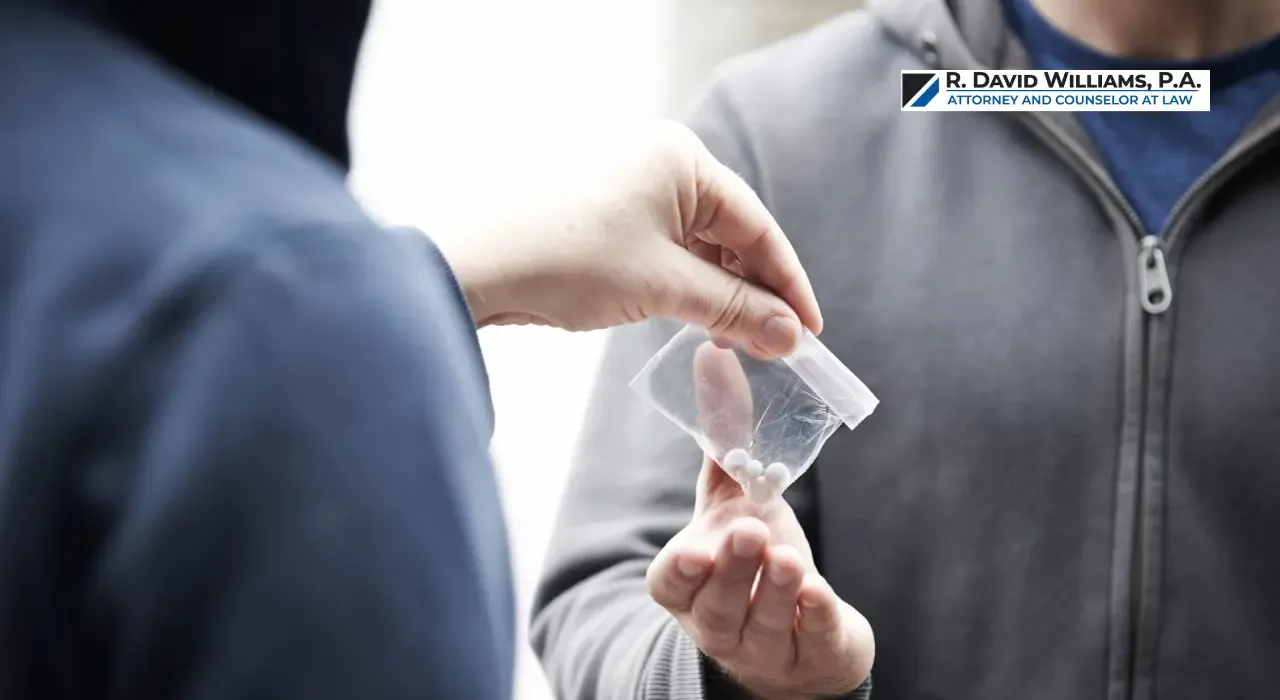
It was supposed to be a ride home. A coworker offered to drop you off after your shift, and her friend was already sitting in the back seat. A few blocks down Sunrise Boulevard, blue lights filled the rearview mirror. The officer said the tag light was out. He asked the driver whether he could search the car, and she said yes before anyone else could speak. Under a pile of napkins in the center console, he found a plastic bag of pills. No one in the car said they were theirs. Twenty minutes later, all three of you were in handcuffs.
Now you're replaying that ride and asking yourself the same question over and over: how can you be charged with drugs you never touched, never saw, and didn't know were there? Under Florida law, the answer comes down to a legal theory called constructive possession of drugs. It lets the State charge people who were near the drugs, but proving the charge takes far more than showing where you were sitting.
The short answer: Police can arrest each person in a car when they have probable cause to believe any or all of them possessed the drugs. To convict you, though, the State must prove beyond a reasonable doubt that you knew the drugs were there and had the ability to control them. Because a shared car isn't in your exclusive control, being close to the drugs isn't enough on its own.
At a Glance
- Florida law treats actual and constructive possession as the same crime with the same penalties
- Constructive possession requires proof that you knew the drugs were present and could exercise control over them
- In a car with more than one person, the State needs independent evidence tying you to the drugs, beyond being nearby
- Drugs in plain view, your own statements, and your personal belongings mixed with the drugs are common ways prosecutors try to make that connection
- Possession of most controlled substances is a third-degree felony carrying up to five years in prison
- An unlawful search can lead a court to suppress the drugs as evidence
- What you say at the scene and afterward can become the State's strongest evidence
Can Police Arrest Everyone in the Car When They Find Drugs?
Yes. Being arrested and being convicted are separate questions, though, and the difference between them is the core of your case.
In Maryland v. Pringle, 540 U.S. 366 (2003), an officer stopped a car with three men inside, found cash in the glove compartment and cocaine behind the back-seat armrest, and arrested all three after each denied the drugs were his. The U.S. Supreme Court held that the officer had probable cause to arrest the front-seat passenger, because it was reasonable to infer that any or all of the occupants knew about and controlled the cocaine.
Although the case came from Maryland, it governs arrests in Florida, too. Florida’s Constitution requires its courts to follow the U.S. Supreme Court’s Fourth Amendment rulings on search and seizure.
Pringle answered only whether the arrest was lawful. It didn't decide whether that evidence was enough to convict anyone. Probable cause is a low bar that lets a police officer make an arrest. A conviction requires proof beyond a reasonable doubt that you personally possessed the drugs. That's where constructive possession cases are won and lost in the criminal justice system.
Actual Possession vs. Constructive Possession Under Florida Law
Florida Statutes § 893.13(6)(a) makes it a crime to be in "actual or constructive possession" of a controlled substance unless you lawfully obtained it from a practitioner or under a valid prescription. Under Florida drug possession laws, both forms of possession carry identical penalties.
- Actual possession means the drugs were on you: in your hand, your pocket, or a bag you were holding.
- Constructive possession means the drugs weren't on you, but the State claims you still possessed them. The Florida Supreme Court has explained that constructive possession exists when a person without physical possession knows the substance is present and has the ability to maintain control over it (Brown v. State, 428 So. 2d 250 (Fla. 1983)).
To prove constructive possession, the prosecution must establish two key elements.
Knowledge that the drugs were there
The State must prove you knew the controlled substance was present. Pills hidden under napkins in a console you never opened present a very different picture than a bag sitting on the seat next to you.
Ability to exercise control
The State must also prove you had the ability to exercise control over the drugs. Being able to reach something isn't the same as having control over it, and that gap widens when someone else owns the car or the bag.
Knowledge of the illicit nature: a separate issue
Florida treats one form of knowledge differently. Under § 893.101, knowing the substance was illegal isn't something the State must prove. Instead, lack of knowledge of the illicit nature of the substance is an affirmative defense you can raise. If you raise it, the jury may presume you knew what the substance was. This defense is different from saying you didn't know the drugs were in the car at all, which the State must still prove.
Why Shared Cars Change Constructive Possession Cases
Whether anyone else had access to the space is the most important fact in a drugs-in-a-car case. When a place is in your exclusive control, such as a car you were driving alone, a jury may infer that you knew about and controlled what was inside. When a place is shared, that inference disappears.
The Florida Supreme Court held in Brown that when premises are in joint possession, knowledge of the drugs and the ability to control them can't be inferred and must be established by independent proof. Florida appellate courts apply the same rule to cars with more than one occupant: proximity to the drugs alone won't support a conviction.
Drugs in plain view change the knowledge question, but not the control question. In Brown, a case involving a house rather than a car, the Court found that drugs in plain view proved the owner knew they were there, and his status as the resident owner proved control.
The Court also pointed to an earlier case where a guest saw drugs in plain view but had no control over the premises, and that evidence wasn't enough. For a passenger, a bag on the dashboard can make it easier for the State to argue you knew about the drugs. The State still has to prove you had the ability to control them.
Passengers, Drivers, and Owners Face Different Levels of Risk
So, can a passenger be charged with drug possession in Florida? Yes, and passengers often are, as the arrest in the opening story shows. But your seat, ownership, and control of the car each change what the State has to prove.
| Your Role | What Prosecutors Point To | Where the Case Is Weak |
| Passenger | Drugs near your seat, your belongings nearby | You had no control over the car or closed compartments |
| Driver | Control of the vehicle | Others had equal access to the area |
| Owner, not driving | Ownership and regular use | Someone else was driving and controlled the car that day |
| Sole occupant | Exclusive control of the car | Others recently drove or borrowed it |
When you're the passenger
As a passenger in someone else's car, you don't control the glove compartment, the console, or the trunk in the way an owner does. Unless the State has something more, such as a statement, the drugs in your own bag, or drugs in plain view at your feet, proving you knew about and controlled the drugs becomes difficult.
When you're the driver
Drivers face more exposure because they control the vehicle. Still, if a passenger had equal access to where the drugs were found, the State must present independent proof connecting you, the driver, to the drugs.
Borrowed and rental cars
If you borrowed a friend's car or rented one, other people had access to it before you. Prior users, rental records, and how long you'd had the car can all become part of your defense.
Where the Drugs Were Found Can Change the Case
Where officers found the drugs affects how strongly the evidence points to any single person. Common scenarios include:
- Glove compartment or center console: Shared between the front seats, and often closed, which weakens any inference of knowledge
- Under a specific seat: Prosecutors argue the person sitting there had control, but anyone in the car could have slid something underneath
- Trunk: Usually tied to the driver or owner, and rarely to passengers
- A personal bag or purse: Personal belongings point toward their owner. A backpack with your ID inside is much harder to defend than a bag no one claims
- Plain view: Drugs out in the open strengthen the State's argument on knowledge, though the State must still prove each person could control them
Evidence Prosecutors Use to Prove Constructive Possession
Because the State can't rely on proximity in a shared car, prosecutors build constructive possession cases with circumstantial evidence. Look for these in the police report:
- Statements you made at the scene, in the patrol car, or on a jail phone call
- Witness statements from other passengers trying to clear themselves
- Text messages or phone records discussing drugs
- Fingerprints or DNA on the packaging
- Your wallet, mail, or prescriptions mixed in with the drugs
- Cash, scales, or baggies near you
- Movements the officer describes, such as reaching toward the console during the stop
Without evidence like this, the State may not be able to prove possession at all.
How an Illegal Search and Seizure in Florida Can End the Case
Before arguing about who the drugs belonged to, your defense should examine how police found them. The Fourth Amendment and Article I, Section 12 of the Florida Constitution protect you against unreasonable searches and seizures. If police violated your constitutional rights, the court may suppress the drugs. If the court suppresses the drugs and the State has no other admissible evidence, the prosecution can't go forward. Whether you can challenge a particular search, and whether an exception to the warrant requirement applies, depends on the facts of your stop.
In a car stop, an illegal search and seizure in Florida can arise from:
- A stop made without a valid legal reason
- A stop held longer than its purpose justified so officers could look for drugs
- A search without a warrant, valid consent, or probable cause
- Consent that was coerced, or given by someone without authority over the area searched
Passengers aren't left out of this protection. A passenger is seized during a traffic stop and can challenge whether the stop itself was lawful. When officers have probable cause to search a car, though, they may search containers inside it, including passengers' bags, that could hold the drugs they're looking for. Whether police conduct stayed within those limits is often the first question in an unlawful search challenge.
Drug Possession Penalties in Florida Don't Change Under Either Theory
A constructive possession conviction carries the same drug possession penalties in Florida as actual possession. Under § 893.13(6):
- Third-degree felony: Possession of most controlled substances, including Schedule II drugs such as cocaine and oxycodone and Schedule III substances such as anabolic steroids, is punishable by up to five years in prison and a $5,000 fine
- First-degree misdemeanor: Possession of 20 grams or less of cannabis is punishable by up to one year in jail and a $1,000 fine
- First-degree felony: Possession of more than 10 grams of specific listed Schedule I and Schedule II substances is a first-degree felony, punishable by up to 30 years in prison
- Second-degree misdemeanor: Possession of a Schedule V substance
Penalties increase for selling, delivering, or possessing with intent to sell near schools, child care facilities, parks, and other protected locations. If the drugs weigh enough to meet Florida's trafficking thresholds, the charge moves to drug trafficking, which carries mandatory minimum prison terms.
A conviction also creates a permanent criminal record. If the court adjudicates you guilty, Florida law doesn't allow that record to be sealed or expunged under the state's standard sealing and expungement procedures.
Sealing or expungement may be available only in narrower situations, such as when the charge is dismissed or the court withholds adjudication, and eligibility depends on your record. A conviction can affect your job, housing, professional licenses, education opportunities, your right to vote until your sentence is complete, and your right to own a firearm.
Legal Defenses in Constructive Possession Cases
Several defenses can apply when police find drugs in a shared car:
- No knowledge: You didn't know the drugs were in the car
- No control: The drugs were in a closed compartment, someone else's bag, or an area you couldn't control
- Mere proximity: The State has nothing beyond where you were sitting
- Unlawful search: The stop or search violated your Fourth Amendment rights
- Valid prescription: The medication was lawfully prescribed to you
- Lab testing errors: The substance wasn't properly identified, weighed, or tracked
- Illicit nature defense: You didn't know the substance was a controlled substance, under § 893.101
Your attorney can attack the case in two separate ways before trial. A motion to suppress challenges how police obtained the evidence. A sworn motion to dismiss under Florida Rule of Criminal Procedure 3.190(c)(4) argues that the material facts aren't in dispute and don't establish a case against you, such as when the State's own evidence shows nothing beyond proximity.
The State can defeat that motion by filing a sworn response identifying a material factual dispute. The motion applies when no material facts are disputed and the undisputed facts fail to establish a prima facie case. These common defenses give an experienced criminal defense attorney a strong defense to build from early in the legal process.
What to Do If Police Find Drugs in a Car You're In
The steps you take during and after the stop can protect your case:
- Remain silent. You don't need to explain, accuse anyone, or say whose drugs they were. Statements are what prosecutors want to prove possession.
- Say clearly that you don't consent to a search, but don't physically resist.
- Don't discuss the case with the other passengers. Calls from the jail are recorded, and a codefendant may become a witness against you.
- Write down what you remember as soon as you can: where you sat, who owned the car, and what you saw.
- Call a criminal defense attorney before talking to law enforcement or the prosecutor.
Frequently Asked Questions
Can police find drugs in a car and charge everyone?
Police can arrest each occupant when they have probable cause. A conviction still requires proof that each person knew about the drugs and could control them.
Can I be charged for drugs found under my seat if they weren't mine?
You can be charged, but in a shared car, the State needs more than the location of your seat to convict you.
Does the driver automatically get charged?
No. Drivers often face charges because they control the car, but when passengers had equal access, the State must prove the driver knew about the drugs.
What if the drugs were in someone else's bag?
Drugs inside another person's personal belongings point toward that person, which weakens any case against you.
What if another passenger says the drugs belonged to them?
That admission can be powerful evidence for your defense. Your attorney should preserve it immediately.
Does it matter if the drugs were in plain view?
Yes. Drugs out in the open make it easier for the State to argue that each person in the car knew they were there. The State must still prove each person could control them.
Can constructive possession lead to a trafficking charge?
Yes. If the amount found meets Florida's trafficking threshold, the State can pursue trafficking on a constructive possession theory.
Can a constructive possession charge be dismissed?
Yes. If the evidence shows only proximity, or if the search was unlawful, your attorney can file motions to dismiss the charge or suppress the evidence.
Get Answers About a Charge That Started in Someone Else's Car
Riding in a car where police found drugs doesn't settle whether the State can prove you possessed them. What decides your case is the evidence connecting you to those drugs, how the search happened, and whether the prosecution has anything beyond where you were sitting.
When you contact the Law Offices of R. David Williams, P.A., you speak with me directly. I'm David Williams, a Fort Lauderdale drug crime lawyer who has represented people accused of crimes throughout Dade, Broward, and Palm Beach Counties for more than 25 years. My background in psychology gives me insight into how frightening it is to face a charge over something you didn't do, and I take the time to hear your side of what happened.
I'll review the stop, the search, and the evidence the State is relying on. I'll explain where the prosecution's case is weak and what defense options fit the facts of your arrest.
Call (954) 522-9997 for a free consultation, or reach out through our confidential online form. Our law offices assist clients in English and Spanish.
Knowledge | Experience | Integrity – R. David Williams
Copyright © 2026. Law Offices of R. David Williams, P.A. All rights reserved.
The information in this blog post (post) is provided for general informational purposes only and may not reflect the current law in your jurisdiction. No information in this post should be construed as legal advice from the individual author or the law firm, nor is it intended to be a substitute for legal counsel on any subject matter. No reader of this post should act or refrain from acting based on any information included in or accessible through this post without seeking the appropriate legal or other professional advice on the particular facts and circumstances at issue from a lawyer licensed in the recipient’s state, country, or other appropriate licensing jurisdiction.
Law Offices of R. David Williams, P.A.
15 Southwest 10th Street
Fort Lauderdale, FL 33315
(954) 522-9997
https://dwilliamslaw.com/